
Steve McManaman: "My mother died the day after I left Liverpool for Real Madrid"
Former England midfielder backs Teenage Cancer Trust’s new Fantasy Football print collection alongside amputee footballer Shelbee Clarke and pundit Rachel Brown-Finnis.
- Published:
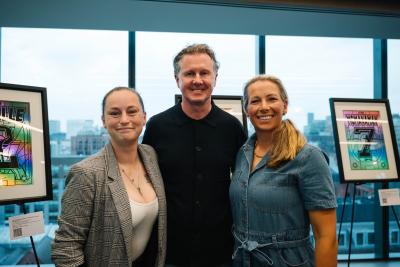
Steve McManaman spoke powerfully about his mother’s death at a Teenage Cancer Trust event last week. “My mother had been ill for a number of years and I knew she was going to pass,” he said. “Weirdly enough, I played my last game at Anfield, had a little reception — and then she died the next day. It was like she was hanging on for me.”
Steve was talking at the Manchester launch of Fantasy Football, a new limited-edition signed print series raising funds for Teenage Cancer Trust’s vital work supporting teenagers and young adults with cancer.
The prints feature the silhouettes of 11 footballers — including Gary Neville, Peter Crouch, Frank Lampard, Kelly Smith and Ellen White — hand-signed by the players themselves, and created by artist Ben Beech. They are available from the Teenage Cancer Trust shop now at £75 each.
McManaman appeared alongside amputee footballer Shelbee Clarke for the launch, and the two shared stories about the moments that shaped their careers and their lives. The conversation was hosted by pundit and former goalkeeper Rachel Brown-Finnis.
Starting their football journeys
McManaman grew up in Liverpool in the 1970s and 1980s, where football was part of everyday life.
“People worked hard, then watched Liverpool and Everton at the end of the week,” he said. “Everton won a lot of stuff, and I was absolutely transfixed.”
He supported Everton well into his teens, inspired by Duncan McKenzie, Bob Latchford and the successful side of the mid-1980s. He went to matches with his dad, and those trips meant as much as anything that happened on the pitch.
“These things bring you together, they were the special times watching Everton take podium after podium. And then a couple of years later, I was climbing the steps myself when we won in ‘92. It was quite surreal.”
Clarke’s teenage years took a very different turn. At 18, with a football scholarship in the United States on the horizon, she was diagnosed with cancer after six months of symptoms that were repeatedly dismissed.
“It was a seven-inch tumour in my pelvis,” she said. “So everything stopped.”
Teenage Cancer Trust absolutely saved my life in many, many ways — and not just in terms of the treatment I received
Overcoming challenges
What followed was years of treatment, amputation and a complete rethink of what her future in football might look like. During that time she was supported by Teenage Cancer Trust.
“Teenage Cancer Trust absolutely saved my life in many, many ways — and not just in terms of the treatment I received,” she said. “The staff and patients were family. The people who were there day in, day out made all the difference.”
Clarke went on to become the first – and for a long time, only - woman in the country to play amputee football alongside men.
Both footballers spoke about the importance of keeping moving forward when it comes to overcoming challenges.
Shelbee said: “When I was on treatment, I learned I can’t control my tumour growing. Me being upset isn’t going to make a difference. What I could control was bringing energy every day and trying to find the light. It really does make a difference.”
Steve also spoke openly about dealing with public criticism and finding the resilience to keep going.
“The newspapers would go to town on you sometimes, and you had to be able to take it, fight it off, and think: well, next time I’ll prove you wrong. But what can you do? You just had to keep on moving forward.”
Friends, family and team-mates
A clear theme in both conversations was the role other people played — teammates, family members and staff who kept showing up when it mattered most.
Looking back on a career that took him from Liverpool to Real Madrid, McManaman said the thing he misses most is that sense of shared life around the game. Players are more professional than ever now, he said, but maybe less connected too.
“I don’t know whether it’s as enjoyable anymore. People don’t go out together, they go back to their own bubbles with their own chefs. It’s very professional, but I don’t know if the same enjoyment is there.”
For Clarke, the community she found on a Teenage Cancer Trust unit helped her through the hardest parts of treatment.
“Staff and patients were family — not just a team, a big family. I wouldn’t have got through my hardest nights without them. The people who were there day in day out were the staff, and they were the difference between life and death.”
Supporting Teenage Cancer Trust
Micky England, Head of Music Merchandise at Teenage Cancer Trust, said: “Most of us have grown up watching a favourite player, celebrating their successes and commiserating over their losses. For many it’s a core part of being young – but it’s also one of the many things that can be derailed by a cancer diagnosis. Teenage Cancer Trust exists because cancer care wasn’t made for young people, but thanks to these legendary footballers who have supported this project, we can be there for more young people with cancer when they need us the most.”
Cancer kills more teenagers and young adults in the UK than any other disease and every few hours, a young person in the UK is diagnosed. Yet often they fall through the cracks between children’s and adult care. Teenage Cancer Trust is the only UK charity providing the specialised nursing care and expert youth support they need.
They fund specialist nurses, youth workers and 28 units within NHS hospitals so young people get the right care and support at the hardest time of their lives.
The event was supported by Hill Dickinson, and held at their new Manchester offices at No. 1 St Michael’s.