
#AndYoungPeople campaign - what next?
We’ve had a great response to our campaign but we’re not stopping now
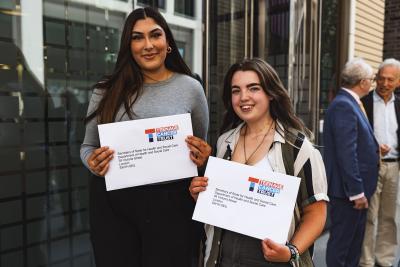
Our #AndYoungPeople campaign set out to ensure that young people weren’t overlooked in the National Cancer Plan for England.
More than 2,000 people signed our open letter calling on the government to ensure that the needs of young people with cancer were included in the Plan.
And we’re proud to say that now, for the first time, England’s cancer strategy includes a dedicated chapter for children, teenagers and young adults – a vital recognition that they deserve care designed specifically for them.
But we’re not stopping here – we’re determined to make sure that the plan becomes a reality and young people with cancer in England see real change.
Why does this matter?
Cancer is different for teenagers and young adults than it is for children and older adults – and yet they’re often overlooked.
For example, teenagers and young adults often take longer to get diagnosed and are the age group most likely to have to see a GP three times or more before they are referred.
There are three key areas where we believe improvements need to be made:
Faster Diagnosis
We’re calling for support and training for GPs and healthcare professionals so that they can increase their awareness of symptoms of cancer in young people. We also believe that a public health campaign to raise awareness of the main symptoms of cancer in the young is urgently needed.
Read Clayton’s story, talking about the need for faster diagnosis.
Mental Health Support
We believe that in every UK nation, every teenage and young adult with cancer must be able to access expert psychological support from a trained psychologist from the point of diagnosis and for a minimum of two years post-treatment.
Read more about how cancer can affect young people with cancer’s mental health.
Clinical Trials
Every young person with cancer in the UK should have the opportunity to participate in a clinical trial where a suitable one is available.
We know from our experience working with teenagers and young adults across the UK that currently too many young people are unable to access clinical trials.
#AndYoungPeople letter hand-in at Parliament
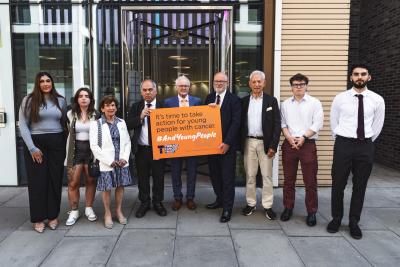
Young people who've experienced Teenage Cancer Trust's specialist care handed in the letter, joined by our founders and MP Champions.
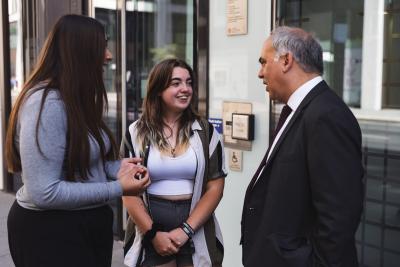
Mariam and Phoebe speak to Bambos Charalambous MP about the campaign
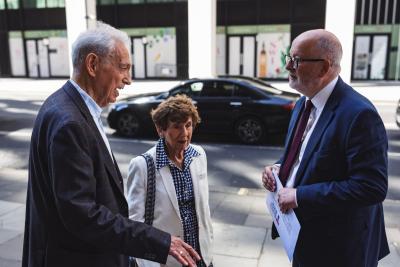
Teenage Cancer Trust founders Adrian and Myrna Whiteson with Steve Yemm MP
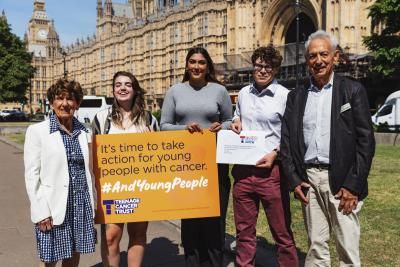
Phoebe, Mariam and Josh with our founders Myrna and Adrian Whiteson.
What we’re doing next
At Teenage Cancer Trust, our work doesn’t stop here. With the National Cancer Plan for England now in place, we’re working to make sure promises turn into real change. Ensuring clear accountability and dedicated resource will be key to unlocking the Plan’s potential for young people. We will continue to:
- Hold Government and the NHS to account on delivering improved clinical trial access, stronger mental health provision and better diagnosis.
- Monitor progress of each commitment, to ensure no promises are left to the wayside.
- Call for improved national data collection so that teenagers and young adults are visible in the numbers, not lost between child and adult datasets. This will help us understand better if the plan’s ambitions deliver for young people.
- Campaign so every young person gets a better experience of diagnosis, treatment and support.

Devolved nations
Because healthcare is devolved, the National Cancer Plan is specific to England, but we also campaign for young people in Wales and Scotland.
Ahead of the Scottish elections on 7 May, Teenage Cancer Trust is calling on all parliamentary candidates to address the challenges faced by young people who’ve had a cancer diagnosis aged 13-24. The focus of our campaigning is to improve mental health and psychological support provision in the country, and we have been calling on government to fulfil its promise to increase the number of funded specialist psychologists.
Find out more about our work ahead of the Scottish elections.
In Wales, ahead of the Senedd elections on 7 May, Teenage Cancer Trust is urging the next Welsh government to introduce a long-term cancer strategy that considers the needs of 13-24 year olds with cancer. Wales has some of the worst cancer outcomes in Europe, so we’re calling for urgent action ahead of the next Welsh elections. We are carefully monitoring the Wales Improvement Plan, to ensure that teenagers and young people are not left out of plans to improve cancer care.
Find out what we’re calling for from the Welsh National Cancer Strategy.
In Northern Ireland we are calling on the Government to ensure that diagnosing and treating cancer in this age group remains a priority, ensuring that teenagers and young adults are fully represented in healthcare planning and support services.