
How greater access to clinical trials can save lives
Reporter Jayne McCubbin has spoken to Harry and his parents for BBC Breakfast. Harry is an incredible example of why clinical trials are so important to young people with cancer. Unfortunately, it’s much harder for teenagers and young people with cancer to find clinical trials that are open to them – they’re uniquely disadvantaged simply due to their age.
Harry was 17 when the paediatric trial that ultimately saved his life became open to him. The paperwork had to be rushed through ahead of his 18th birthday, otherwise he would’ve been ineligible. He shares why he thinks all young people should have greater access to clinical trials.
Clinical trial
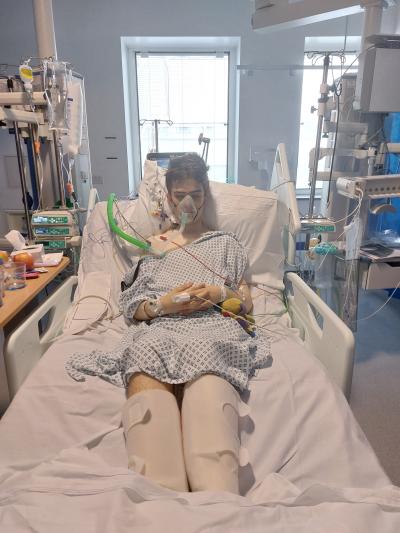
I was so glad to get onto this trial, as at the time, everything else had failed and we were running out of options. The trial gave me some hope. Although this was a paediatric trial, I managed to get the paperwork signed before I turned 18.
When a clinical trial was mentioned my first thought was: ‘Am I going to be a guinea pig?’ But I quickly realised that this wasn’t the case. I was pleased to have the opportunity to receive the best possible treatment and assist patients in the future. I think that all young people should have greater access to clinical trials, particularly young adults where there is a gap in which trials are offered.
Being enrolled on a phase 1 trial and being one of the first patients to receive a new treatment was both exciting and scary. I have yet to meet anyone else who has had it.
The scars left by where IV drip and catheter lines have been and from high dose steroids will always serve as a visual reminder of my experience, however, as they fade, I find myself finding peace with them. This is a trial which I will be part of for the next 15 years.
I would’ve been lost without Teenage Cancer Trust. I would have either been treated on a ward full of young children or with older adults. It would certainly have been much more isolating and difficult.
Being diagnosed with acute lymphoblastic leukaemia
When I was diagnosed, it felt like the previous 17 years of my life were flashing before my eyes. My world was turned upside down. In what felt like a matter of moments, I was started on my first transfusion of platelets and put into an ambulance and rushed the 20 miles to St James Hospital in Leeds. The wailing of the ambulance sirens and the bumpiness of the road as we wound our way to hospital still stays with me, as well as the reassuring words of the paramedic.
I still didn’t believe that I was unwell, even when I was in A&E. I remember looking around the waiting room as I was wheeled past and thinking that all the people looked much more ill than I was, so why was I being taken through first?
I thought that I would be out in no time. I was wrong. They did several scans and I was taken to a bed. My dad was with me when the lead consultant in A&E that evening took my dad to a side room. He came back and told me that they wanted to admit me, and that the consultant would see me shortly.
My mum came down to the hospital and the consultant came to see me. It was then that she told me that I had leukaemia and also a bleed on the brain and retinas. We all broke down in tears but decided there and then that we would get through this together.
Teenage Cancer Trust support
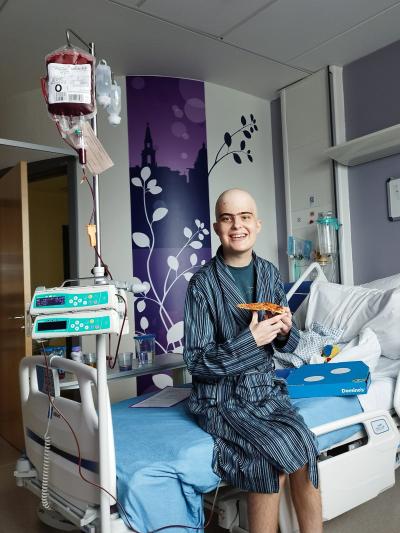
I was first moved to the Teenage Cancer Trust unit from ICU, and it felt like such a relief. I remember how happy I felt my first night there with no beeping and bonging machines and without bright lights on all night.
The staff were instantly friendly and over the months they’ve become like a second family, always doing their utmost for me and advocating for my needs. I’ve got to know them all very well. I was placed in a side room, and it was so bright and uplifting, unlike any other hospital room that I’ve been in. Straight away my mind was taken away from my illness. My younger brother, grandparents and friends could visit at any time which made me feel less lonely.
When I was eventually allowed out of my room, I made it my daily challenge to walk down the ward corridor to the common room to get a packet of crisps and some chocolate which was all the exercise I could manage. Unlike other hospital wards, it felt as though patients were treated as individuals rather than numbers, even when staff were really busy, they always had time for a chat.
As soon as I was moved onto the Teenage Cancer Trust unit, Padma, their Youth Support Coordinator, introduced herself to me. She would regularly come and check on me, ask me how I was, and provide activities to do. She would organise Domino’s pizza takeaways for the ward and would go to Costa to get hot drinks for everyone.
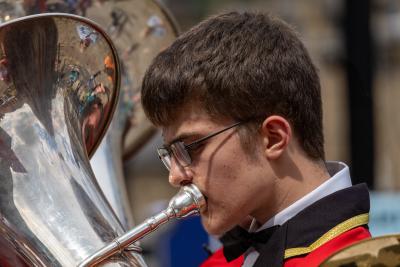
I remember when I had some bad news about my treatment and was really struggling, she organised for some musicians to come into the ward. They brought instruments for people to play, and we all wrote a song together. Music has been a big part of my life. My parents said that when I was taking part in this activity it was the first time they had seen the real Harry in many months smiling and having fun.
When I wasn’t in isolation, it was nice to speak to other young people on the unit with my condition, some of whom were many months ahead with treatment. I learnt that many of my experiences were not unique. Realising that I was not alone greatly helped.
After becoming an outpatient, Padma continued to put on activities and has been someone to talk to, not just for me but for my parents as well. Having someone who is non-clinical is very important.
I would have been lost without Teenage Cancer Trust. I would have either been treated on a ward full of young children or with older adults. It would certainly have been much more isolating and difficult. Without Teenage Cancer Trust I can’t see how I would have gotten through this experience. Their service is invaluable.