
We’re raising awareness of bone cancer symptoms in Alex’s memory
Content warning: reference to death.
Our son (and Ben’s brother) Alex was one of life’s good guys – caring, funny, thoughtful, reliable and hard working. Sadly, he died in March 2026, age 25, after being diagnosed with bone cancer two years earlier. In Alex’s memory we’re raising awareness of bone cancer symptoms in teenagers and young adults.
You are viewing: Bone Cancer Information
At first, cancer never crossed anyone’s mind

Looking back, Alex’s main symptom of bone cancer was intermittent pain in his leg, including pain at night. But we’d just been on a family skiing trip when the pain started, and Alex had a physically demanding job – so at first cancer never crossed anyone’s mind.
He had been to our doctor a few times but didn’t have a scan until 11 months later. Alex wasn’t one to make a fuss. Being young and generally fit, Alex was like any other 22-year-old and just put up with the pain and discomfort and carried on.
I think seeing two different doctors didn’t help. The doctors thought it was muscular damage and he was given anti-inflammatory medicine and exercises to do. Maybe more visits to the doctor would have triggered further investigation and scans.
Towards the end of that year, he was struggling at work and finding it hard to go up and down stairs, so an X-ray was arranged, followed by a biopsy. In February 2024 Alex was diagnosed with spindle cell sarcoma, a rare and aggressive bone cancer.
The delay in diagnosis contributed to the cancer spreading. Having spoken to our family doctor since, he did say that pain at night – which Alex had – can be a red flag.
All GP’s should really ask whether the pain is coming at night too.
Teenage Cancer Trust gave us safety and normality
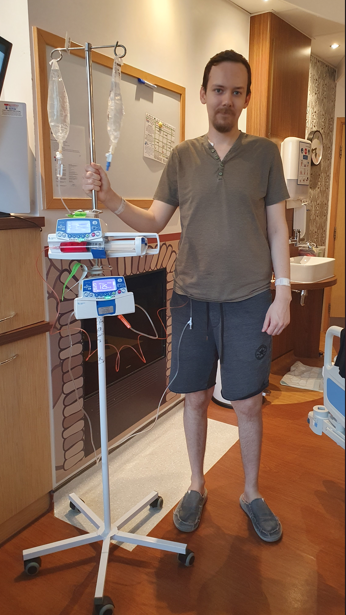
The Teenage Cancer Trust unit in Southampton where Alex had his treatment was invaluable. He also had use of the Teenage Cancer Trust room when he had his operation at the Royal Orthopaedic Hospital in Birmingham. If he’d been in an adult ward, he would have become very depressed, and it would have been very stressful for us too.
It gave Alex the feeling of being safe and knowing that the staff were trained to deal with and understand younger people really helped. He was very grateful to have his own room as he liked his privacy, and to be able to have us there at any time of day was reassuring.
We used the communal area, kitchen and games area a lot – it was nice to have somewhere to sit but still be close to Alex, and he liked the fact that we could cook food for him. The unit gave us some sense of normality.
And having other young people around him showed that he wasn’t the only one in that position. We met one young boy in Southampton who was only 15 years old and also had bone cancer.
We also had great support from Skye, Teenage Cancer Trust’s outreach nurse in Jersey, where we live. Skye was always easy to contact, and Alex found her easy to chat to. She was always there for us and happy to answer any questions – there were quite a few!
At the end of Alex’s treatment in the October, his consultant said he was in remission. Sadly, just before Christmas, a scan showed that the cancer had spread and Alex was given between six months and two years to live.
Alex spent his last three months in Jersey hospice. He’d made lots of lasting friends among his colleagues at Dunelm and during his last week in the hospice, one of them sent a video message saying she would never forget the cookies he baked for the team and for charity days. Even though he was struggling to speak by that time, Alex called them ‘positive cookies’. The saying stuck with us.
Even in young people, cancer does happen
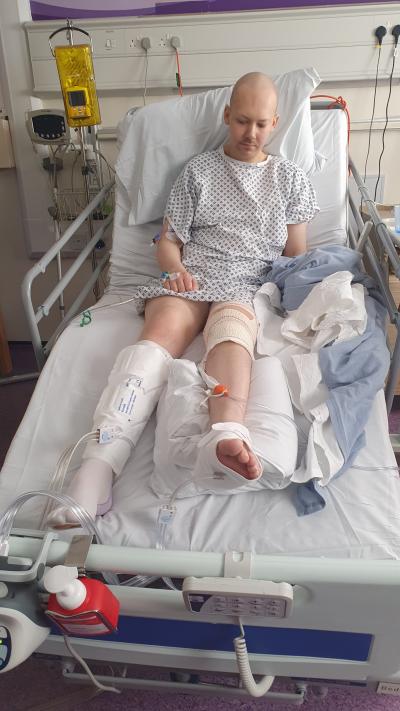
Sadly, Alex passed away in March 2026 after a very brave battle. He never complained about his condition, saying ‘it is what it is’ and just got on with life in the best way he could. He was an amazing human being and a credit to us all.
He was keen that people are made aware that even at his age, bone cancer is a thing, and that the symptoms were only intermittent pain in his leg during the day and night.
I think that cancer awareness should be included in PSHE across all schools to encourage teenagers to go to the doctor and to ask the question ‘Could it be cancer?’ before it’s too late. Doctors do need to be reminded about cancer in teenagers and young adults, as it’s not a common thing for them to come across – but it does happen.
Doctors should also share information with their colleagues and other surgeries in their area about what type of cancer their young patient has, and the symptoms – especially unusual ones. It might just mean that another young person gets their symptoms looked into sooner and could make all the difference for them.